

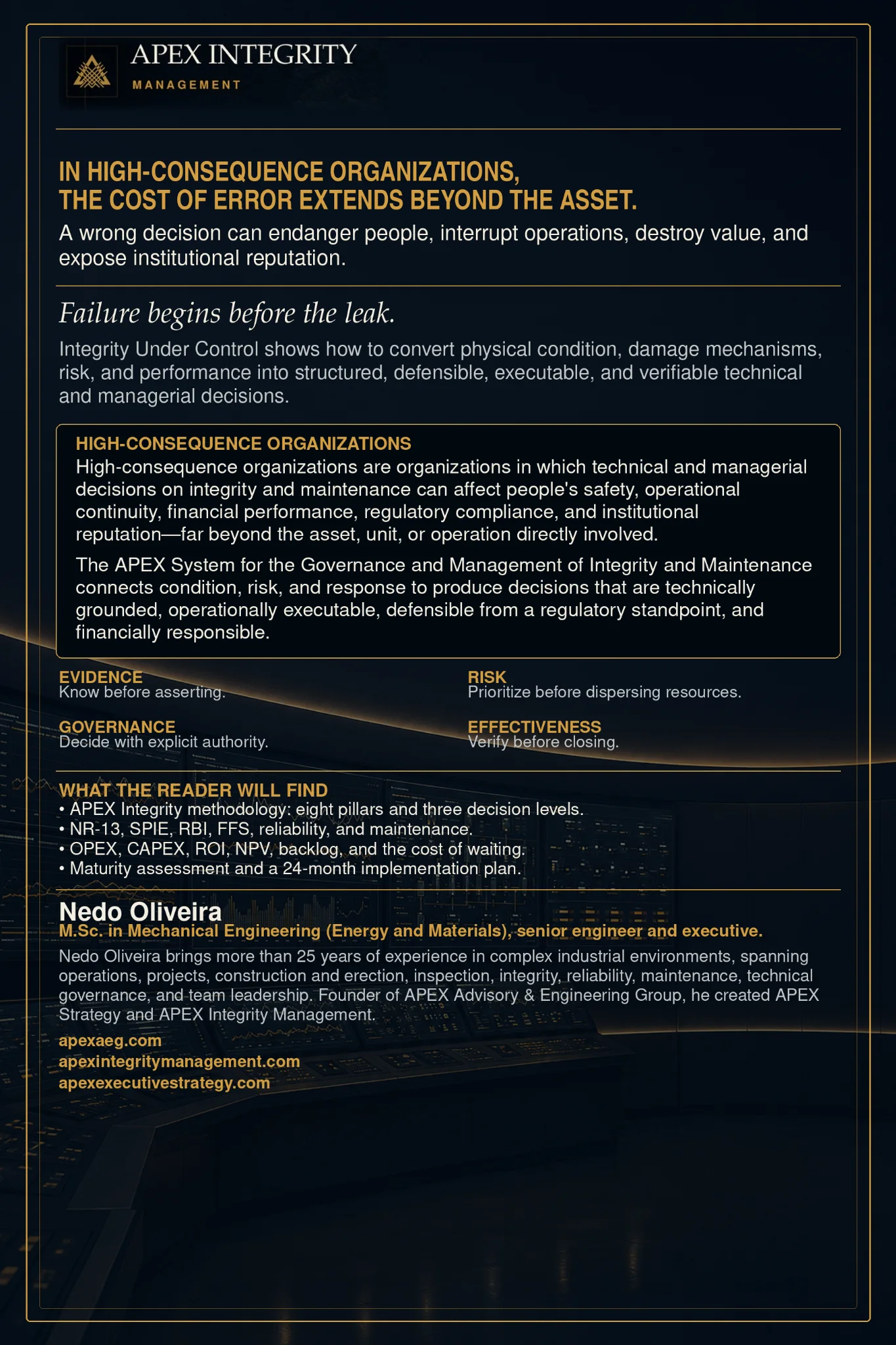
Evidence
Know before asserting.
APEX Integrity Management
Consulting and engineering to preserve function, govern risk and allocate capital across critical assets.
Connecting physical condition, damage mechanisms, risk, reliability, data, authority and capital to produce defensible, executable and verifiable decisions.
Designed for industrial companies, asset operators, managers, engineers and teams responsible for operations, construction and assembly, projects, integrity, reliability and maintenance.
Core concept
When the cost of error reaches beyond the asset, integrity and maintenance management ceases to be merely a technical function. It requires governance: connecting physical condition, damage mechanisms, risk, reliability, data, authority and capital to produce defensible, executable and verifiable decisions.
Know before asserting.
Prioritize before dispersing.
Decide with explicit authority.
Verify before closing.
Institutional context
At APEX Integrity Management, the term describes organizations in which technical and managerial decisions on integrity and maintenance can affect people's safety, operational continuity, financial performance, regulatory compliance and institutional reputation — far beyond the asset, facility or operation directly involved.
Consulting in the governance and management of asset integrity and maintenance
APEX Integrity Management diagnoses, structures and implements systems for the governance and management of asset integrity and maintenance across critical assets, converting technical evidence into executive decisions on risk, performance, intervention and capital.
What APEX diagnoses and implements
Technical capabilities integrated into the system
Diagnosis, governance architecture, implementation and evolution of integrity management systems.
Strategy · organization · performanceBrazilian regulatory compliance, internal audits, gap diagnosis and governance.
Brazil · compliance · auditInspection plans, assessments, technical opinions, technical-financial indicators and learning.
Assurance · traceability · valueCriticality, FMEA, RCM, failure-mode policies and the connection between condition and intervention.
FMEA · RCM · criticalityCircuits, scenarios, probability, consequence and risk-based inspection strategies.
API 580/581 · PoF · CoFFitness-for-service assessments, operating limits, intervals and technically defensible decisions.
API 579-1/ASME FFS-1Proprietary method
APEX System for the Governance and Management of Asset Integrity and Maintenance
A proprietary framework that connects technical knowledge, authority, capital and execution without erasing the specific characteristics of the asset, process or operation.
Eight pillars
Decision levels
Is the decision admissible?
Is the remaining risk governable?
Does the choice sustain function and value?
Engineering that changes decisions
When mechanisms, evidence, risks, decisions, execution and verification remain traceable, the system produces decisions that are technically grounded, operationally executable, defensible under regulatory scrutiny and financially responsible.
Environment, history and operating regime.
How and why degradation evolves.
What the technique can truly demonstrate.
Limit, timing, intervention and residual risk.
Effectiveness confirmed and knowledge updated.
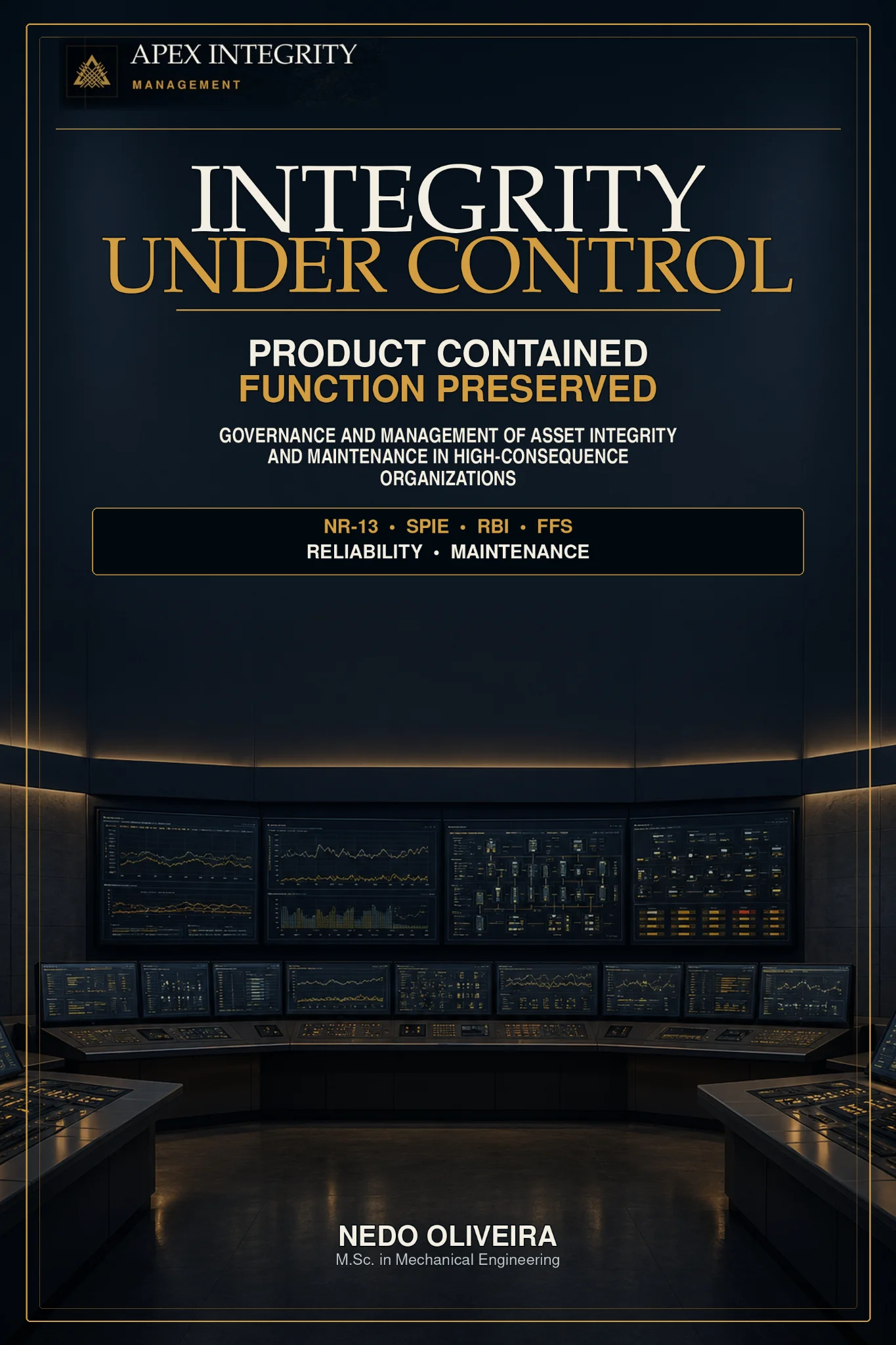
The APEX Integrity book
A book for engineers, technical leaders and executives who must connect degradation physics, risk, governance, reliability and financial decisions.

Founder
MSc in Mechanical Engineering (Energy & Materials), senior engineer and executive.
Nedo Oliveira brings more than 25 years of experience in complex industrial environments, across operations, projects, construction and assembly, inspection, integrity, reliability, maintenance, technical governance and team leadership. Founder of APEX Advisory & Engineering Group (APEX AEG), he created APEX Strategy and APEX Integrity Management.
A technically sound decision must still be understood, funded, executed and verified.Contact us
 APEXSTRATEGY
Complementary capability
Discover APEX Strategy: executive judgment, strategy and decision-making under pressure for high-consequence organizations.